Generative AI & LLM Applications
Structured Data Copilot
Grounded LLM application for generating and validating structured data from live webpages.
Built a retrieval-augmented application that analyzes webpage content, retrieves relevant Schema.org and Google structured-data requirements, generates JSON-LD with GPT-4o, and validates the result before returning it to the user.
Business Problem
Generating structured data is easy. Generating reliable structured data is not.
Structured data helps search engines understand webpage content, but implementing it correctly requires identifying the appropriate schema type, following detailed requirements, and ensuring every field is supported by information actually present on the page.
Problem
Creating JSON-LD manually requires developers to interpret both webpage content and detailed schema requirements.
Challenge
An LLM can generate markup quickly, but unsupported fields, outdated requirements, and fabricated values can make the output unreliable.
Approach
Ground generation in source-page content and retrieved documentation, then validate the result before returning it.
How It Works
Generation as a pipeline, not a single prompt
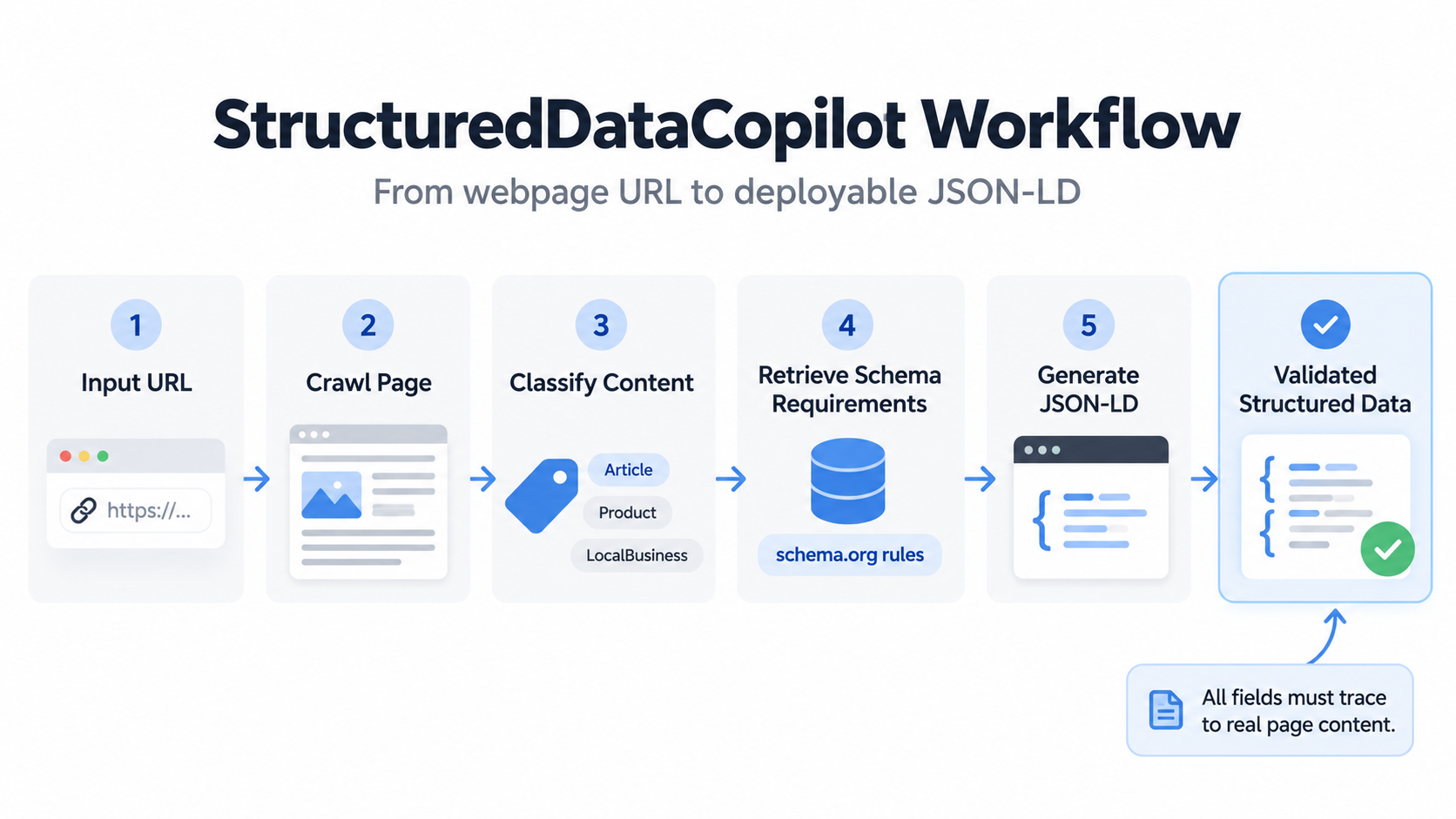
The application breaks the task into separate stages so extraction, retrieval, generation, and validation can each be controlled independently.
Analyze the webpage
Crawl the supplied URL and extract visible page content along with any existing JSON-LD.
Identify the schema
Use page characteristics to determine relevant structured-data types such as Product, Article, Event, or LocalBusiness.
Retrieve documentation
Retrieve relevant Schema.org definitions and Google structured-data requirements from a ChromaDB vector store.
Generate grounded JSON-LD
Provide webpage content and retrieved documentation to GPT-4o as context for generation.
Validate the output
Apply deterministic checks for required fields, schema properties, and structural requirements.
Repair when necessary
Feed validation errors back to the model for correction, with the repair process repeating for up to three iterations.
Grounded Generation
The goal was not just to generate JSON-LD. It was to control what the model was allowed to generate.
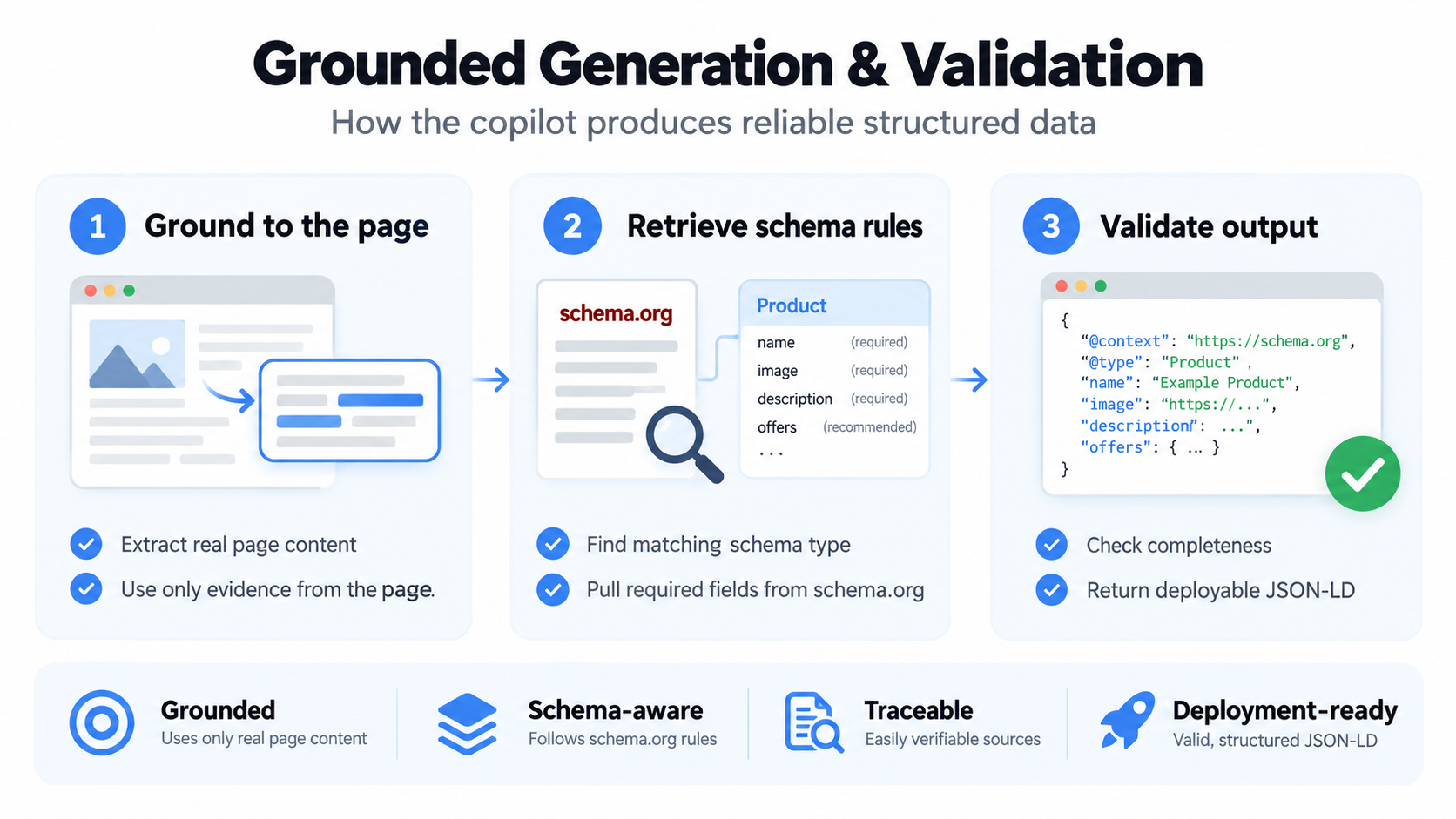
Generated values must come from the webpage or existing structured data. If the source does not provide a value, the model is instructed to omit the field rather than infer or fabricate it.
Retrieval also reduces reliance on the model's training memory. Relevant Schema.org and Google documentation is supplied at generation time so the model can work against retrieved requirements instead of relying only on what it already knows.
Validation & Repair
Treating LLM output as a draft, not the final answer
After generation, the application evaluates the JSON-LD against deterministic validation rules. When errors are detected, the specific failures are passed back to the model so it can revise the markup instead of regenerating blindly.
Output Quality
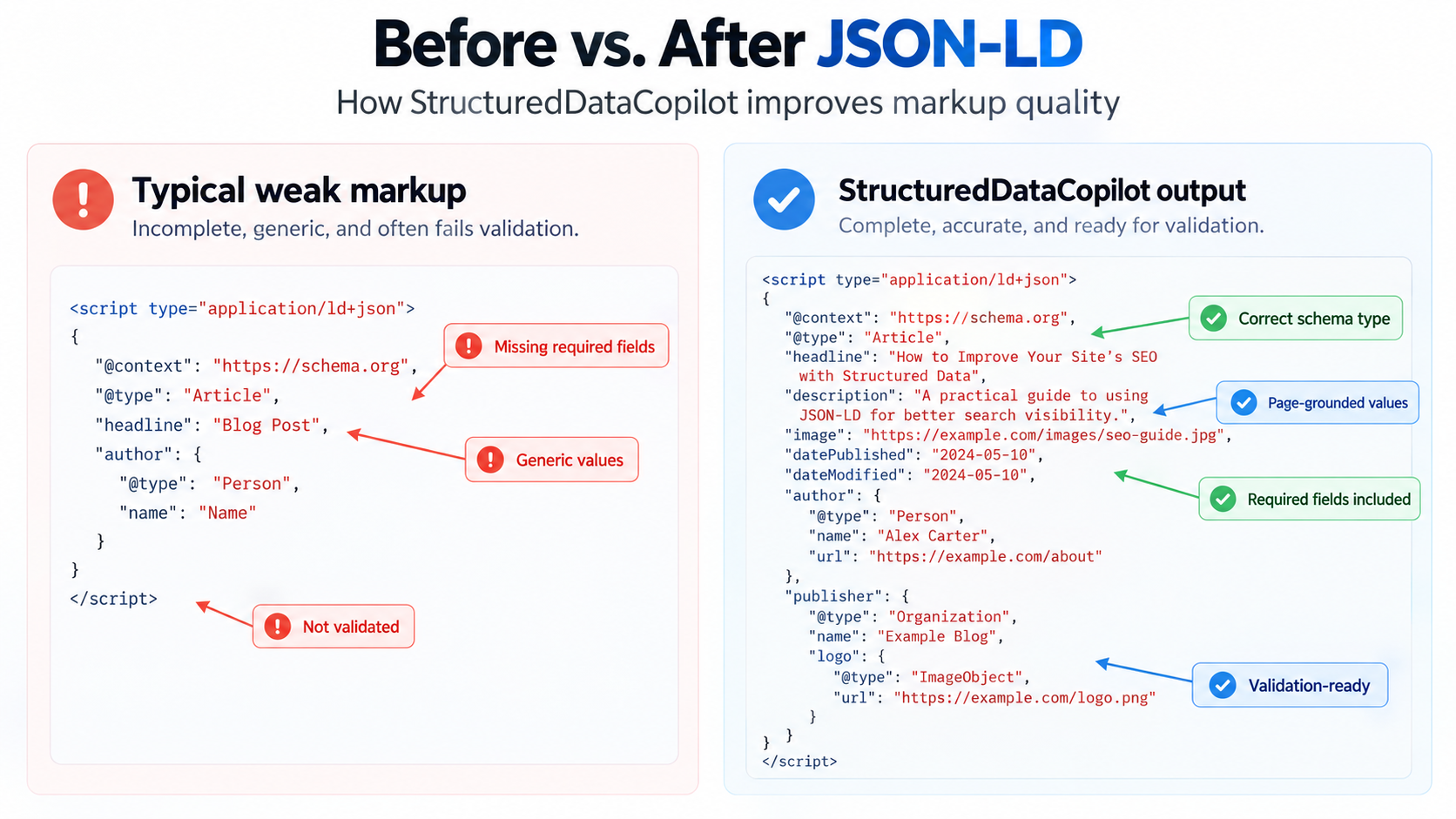
From incomplete markup to grounded, validated JSON-LD
The value of the system is not simply that it generates structured data faster. It improves the quality of the output by grounding values in real page content, applying relevant schema requirements, and validating the result before delivery.
Application Output
Making the result understandable, not just technically correct
Rather than returning only a block of generated JSON, the application is designed to help users understand what was detected, what was generated, and whether the final output passed validation.
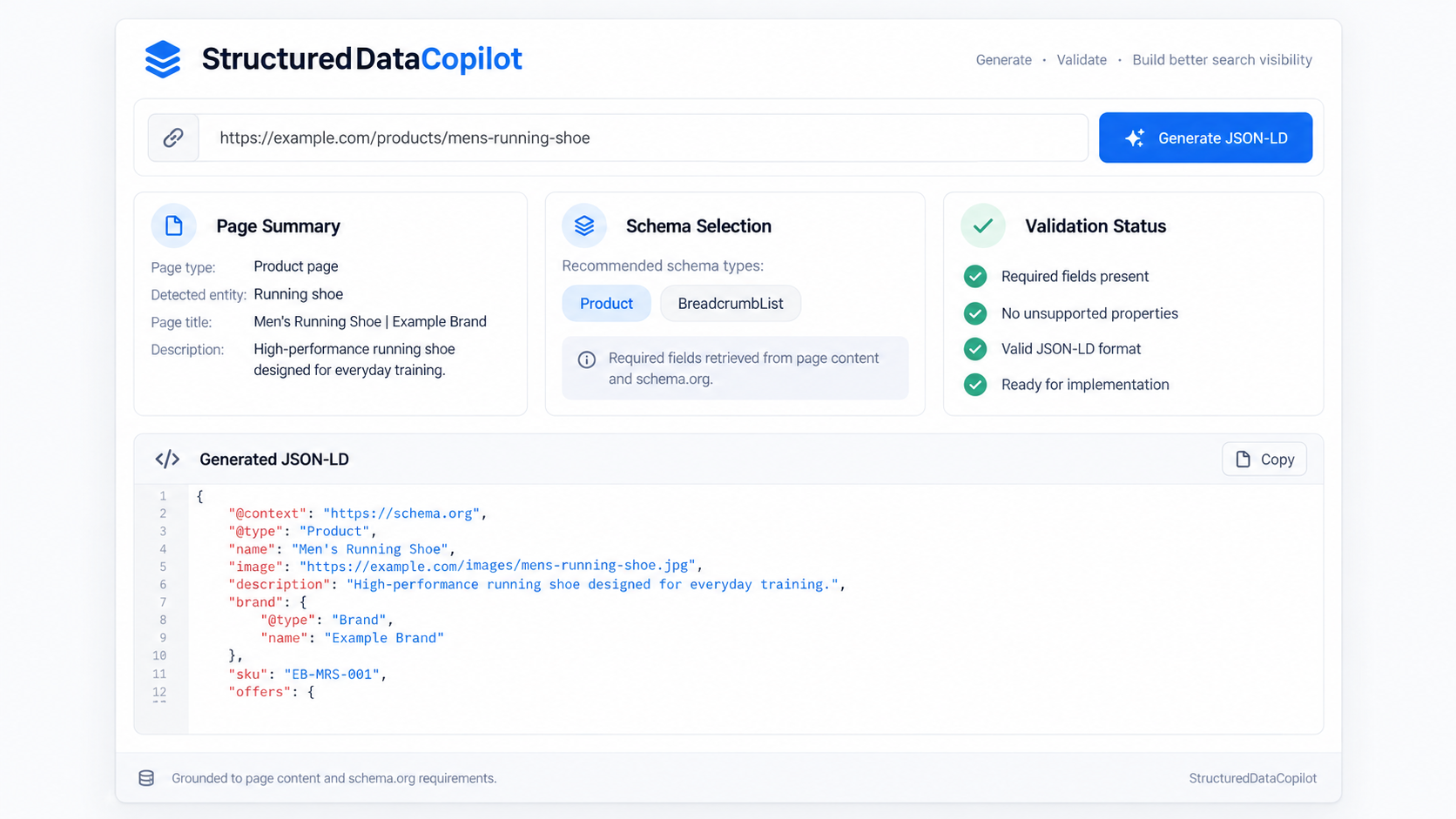
Generated JSON-LD
Structured-data markup produced by the generation pipeline.
Validation Results
Issues detected by the deterministic validation layer.
Before / After Comparison
Changes between existing structured data and the generated result.
Rationale
An explanation of why the recommended structured-data changes were made.
Technical Architecture
Separating retrieval, generation, and control
Backend & API
Python and FastAPI coordinate crawling, retrieval, generation, validation, and repair.
Retrieval
Schema.org and Google documentation are chunked and stored in ChromaDB for schema-specific retrieval.
LLM Layer
Azure OpenAI GPT-4o generates and repairs structured data using retrieved documentation and extracted webpage content.
Frontend
Next.js provides the interface for submitting webpages and reviewing generated markup and validation results.
Takeaway
Building the system around the model
The hardest part of the project was not calling the LLM. It was designing the surrounding system so the model had the right information, operated within clear constraints, and could be checked when it produced an incorrect result.
Retrieval provides context, the LLM handles interpretation and generation, and deterministic code provides control and validation.
View Project on GitHub